ServicesGutters
Gutters in Rossmoor, Chosen for the Years Ahead
We install and repair one-piece gutters, downspouts and the roof-edge flashing that ties them together. You get a system sized for your roof, pitched so water actually drains, and priced with its upkeep in mind, so the gutters you choose today still make sense years from now.
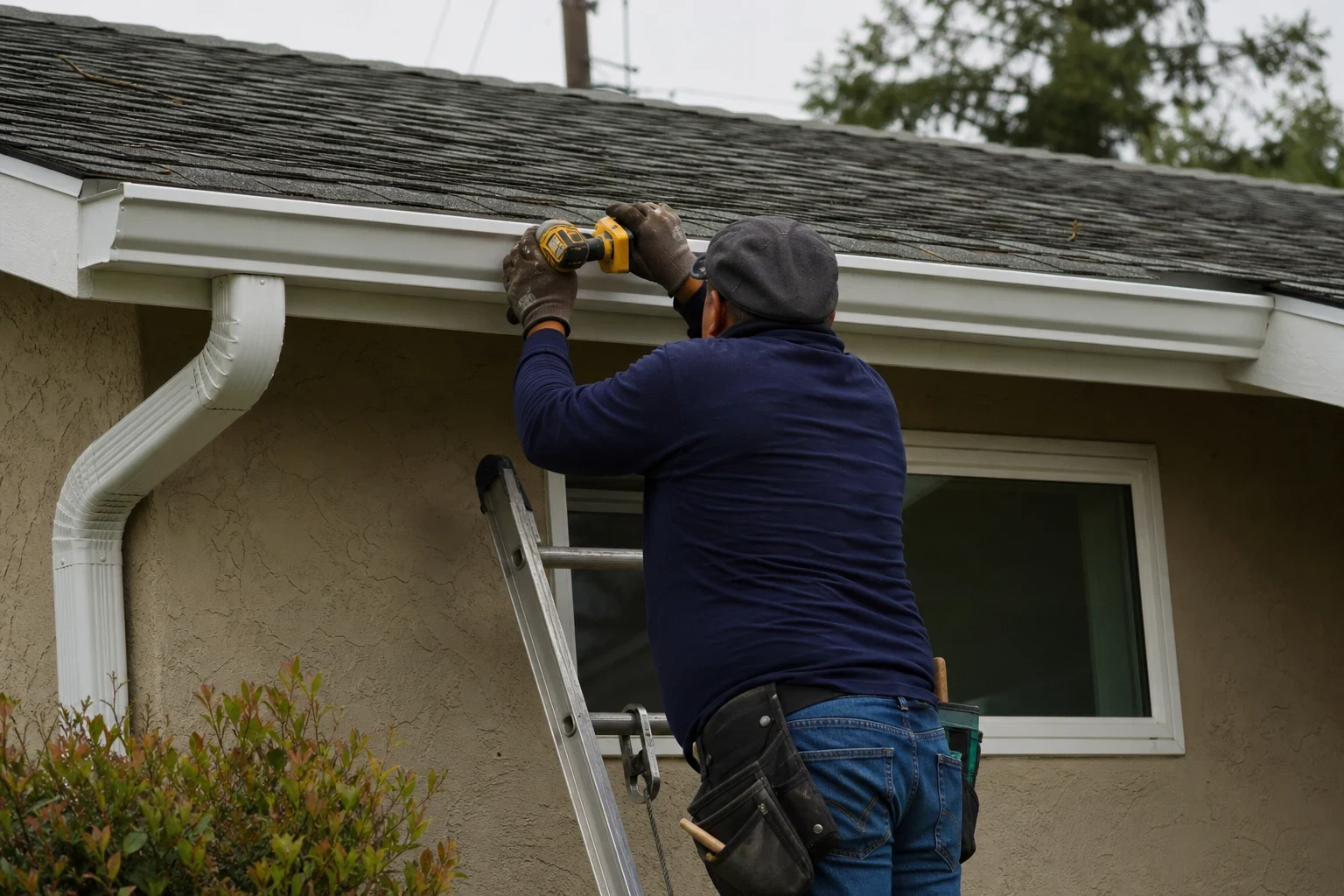
What a well-built gutter system does for your home
Gutters have one job: move roof water away from your fascia, walls and foundation. When they work, you never think about them. When they don't, water soaks the fascia boards, stains stucco, washes out planting beds and finds its way under the edge of the roof itself.
The cheapest option is rarely the least expensive one to own. Sectional gutters snap together from short pieces, and every joint is a seam that will need resealing. Continuous aluminum is rolled out at your home to match each wall from end to end, leaving joints only where a corner turns or a downspout drops. It costs a little more on day one and asks far less of you afterward.
Our rain tends to arrive in a handful of winter storms after a long dry season, which means debris piles up for months and then gets tested all at once. We size and hang gutters for that pattern, and we'll tell you plainly if your current ones only need a cleaning and a few new hangers.
The parts of a gutter job we take care of
Continuous lengths shaped at your curb
A forming machine on our truck turns a coil of aluminum into a gutter cut to the exact length of each wall, in a 5-inch or 6-inch K-style profile. With seams only at corners and outlets, there are far fewer spots where drips and corrosion can begin.
Hidden hangers, closely spaced
We fasten gutters with screw-in hidden hangers set roughly every two feet into solid fascia. They grip far more firmly than the older spike-and-ferrule style, where a long nail works a little looser each time the wood swells and dries.
Correct pitch toward each outlet
A gutter that looks level holds standing water. We set a gentle, measured fall toward each downspout so water keeps moving and debris doesn't settle into a sludge.
Downspouts sized to the roof area
Large or steep roof sections often need oversized 3x4 downspouts or an extra drop. We add extensions or splash blocks so water lands away from the foundation, not beside it.
Drip edge and roof-edge tie-in
Water should pass from the roof into the gutter, never behind it. On shingle roofs, our CertainTeed ShingleMaster credential informs how we fit gutter apron under the first course without disturbing the shingle seal.
Gutter guards when they earn it
If tall trees overhang your roof, a quality guard can cut cleanings sharply. If not, we'll say so and save you the expense.

Signs your gutters need attention
- Overflow at corners during rain
- Water sheeting over the corners usually means undersized gutters, a clogged outlet or too few downspouts for the roof area feeding them.
- Gutters pulling away or sagging
- A gap between gutter and fascia means hangers have loosened or the wood behind them has softened. Left alone, the run can tear free in the next heavy storm.
- Peeling paint or soft fascia
- Blistered paint and spongy wood along the roof edge point to water getting behind the gutter. Catching it early keeps a gutter job from becoming a carpentry job.
- Standing water days after rain
- Puddled water in the trough means the pitch is off. It breeds mosquitoes, adds weight and speeds corrosion at joints.
- Washed-out soil below the eaves
- Small trenches, splashed mud on walls or exposed roots under the drip line tell you water is falling where a gutter should be catching it.
Your gutter job, step by step
- 1
Visit and measuring
We go along the roof edge, check the fascia, measure every run and mark each outlet location. You get photos of what we saw, including the roof edge right above the gutters.
- 2
Options on a written estimate
The free written estimate spells out materials, metal thickness, number of downspouts and any fascia work. When it is useful, a lower-cost option sits next to a longer-lasting one so you can compare.
- 3
Hanging the new gutters
Old gutters come down, soft fascia gets repaired, and the new runs are formed and hung, most often in one day on a typical one-story home. We are a licensed roofing contractor, CSLB 1092407 (C-39), and we are insured.
- 4
Flow test and cleanup
We run water through each section to make sure it drains, then haul away the old metal and pick up loose screws and scraps.
How a gutter estimate adds up
Most of a gutter price comes from three things: how much metal runs along your roof edge, how much ladder work it takes to get there, and the condition of the fascia it mounts to. We go through the estimate line by line with you before work begins. Financing is available through Service Finance Company, subject to credit approval.
- How long and how high the runs are
- A longer roof edge takes more metal, and second-story runs need more setup and time on the ladder.
- Metal type and thickness
- Thicker .032 aluminum holds up to dents and sagging better than lighter stock. Steel and copper cost more and wear differently over time, and we will explain the difference.
- Condition of the fascia
- A gutter is only as secure as the board it hangs on. If overflow has rotted sections of fascia over the years, we replace them first, and you see photos and a separate line for that work before anything starts.
- Extras and tear-out
- More or larger downspouts, guards, and removing and hauling off the old gutters each add to the total.
What people ask us about gutters
- Aluminum, steel or copper: which metal should I pick?
- One-piece aluminum suits most homes: it is light, reasonably priced, lasts a long time and never rusts. Galvanized steel takes harder knocks but can corrode, more so in salty air near the beach. Copper outlives both and weathers to a patina many owners like, though it costs far more. We will go over how each would work on your roof.
- Do gutter guards pay for themselves?
- They do when leaves or needles fall on your roof, since cleanings drop off sharply. Without trees overhead, paying for a cleaning once a year usually costs less over time than guards. We will tell you straight which case fits your house.
- Do I need all new gutters, or can one part be fixed?
- Many times one fix is enough. A leaky corner, a loose hanger or a tired outlet can be repaired by itself. If the gutters are too small or worn from end to end, we will show you why new ones cost less over the years ahead.
- Do you check the roof while you are up there for the gutters?
- Yes. Roof trouble often shows first at the gutter line, like shingle grit in the trough or a cracked tile along the eave. We photograph whatever we spot and point it out, and we handle roof repair as well.
- My gutters were damaged in a storm. Can you work with my insurer?
- Yes, we work directly with your insurance claim. We record the damage in photos and measurements and can meet your adjuster on site. What the policy covers is still up to your insurer.
Gutters that keep earning their keep
Tell us what you're seeing at the roof edge. We'll come out for a free inspection, measure every run and give you a written estimate that compares options by cost and lifespan.